Fast Swim Academy · For the 800 and 1500 freestyle
100 Distance Practices
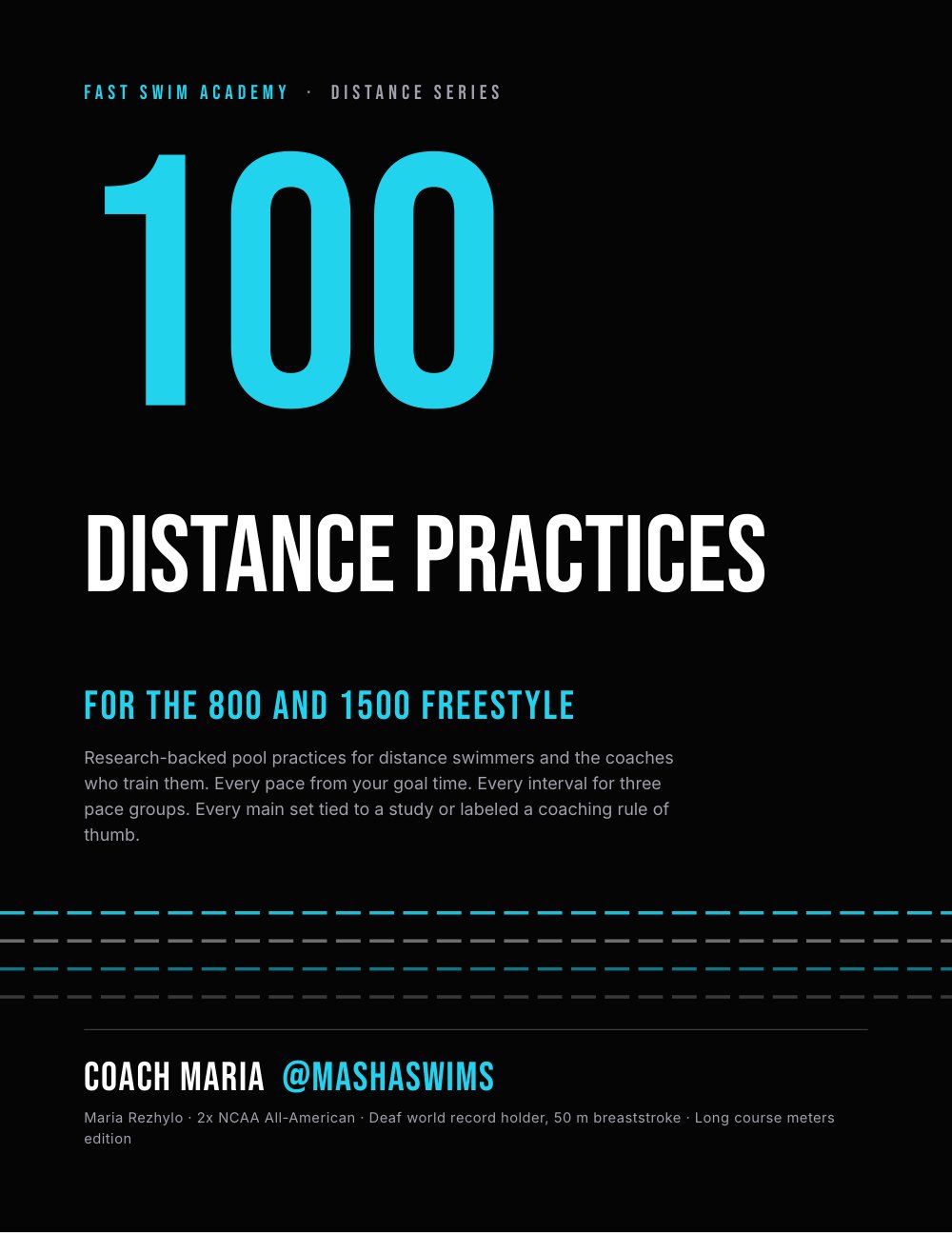
One hundred pool practices for the 800 and 1500. Every pace comes from your goal time, every set prints intervals for three pace groups, and every main set is tied to a study or labeled a coaching rule of thumb. Three blocks take you from early season to meet week without a single garbage meter.
Price goes up to $29 on Oct 27.
Who it is for
Distance swimmers from 13 up, and the people who coach them.
- Age groupers, 13 and upPace group C covers a 1500 around 18 to 20 minutes. Every practice has a developing line with fewer reps and the same rest.
- Club and college distance swimmersGroups A and B, 14:45 to 18:00 for the 1500. Swim the three blocks in order, with race pace in most mid-season practices.
- Masters who race the 800 and the milePaces come from your own goal time, so the intervals fit whatever speed you swim. Typical practices run 3,400 to 4,500 meters.
- 800 specialists and 1500 specialistsEvery practice is tagged: 27 written for the 800 alone, 34 for the 1500, 39 for both.
- CoachesThree intervals printed on every set, one lane per pace group, and the research behind each main set your swimmers can read for themselves.
Inside the book
Every set has a job.
One hundred practices, each on its own page in the same layout: title, purpose, event fit, total distance and time, then warm-up, drills, main set and cool-down with intervals for groups A, B and C. The bottom of every page gives the research, one cue and a scaling line. Eight short science chapters open the book and explain the rules. A drill library and a practice finder sit before practice 1.
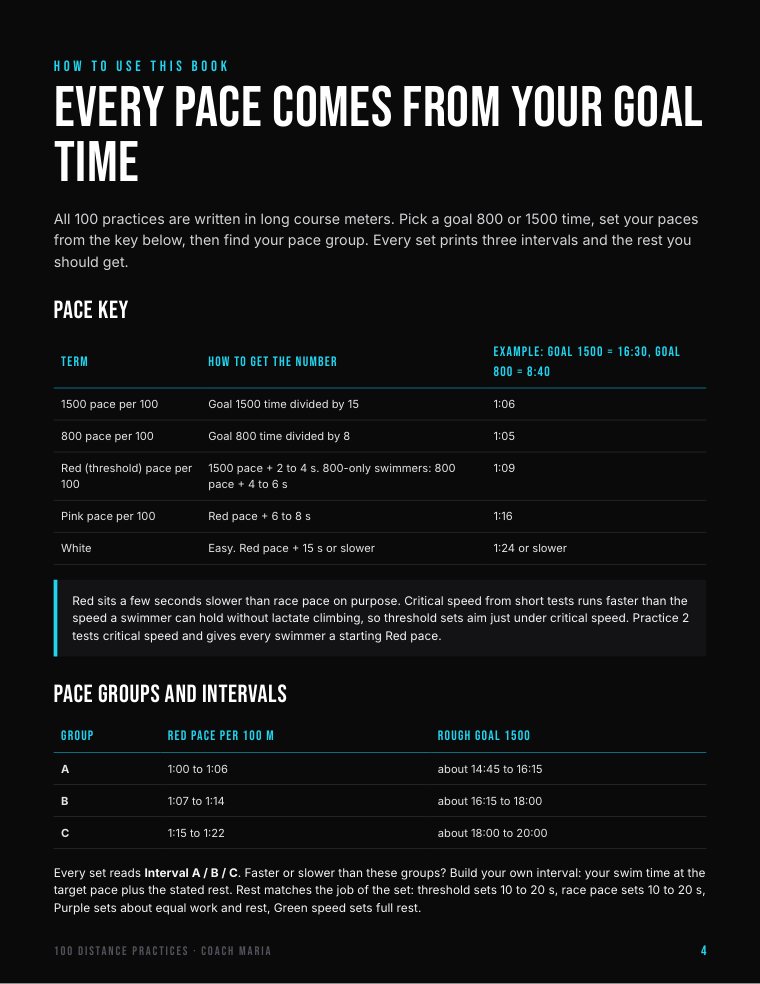 Page 4
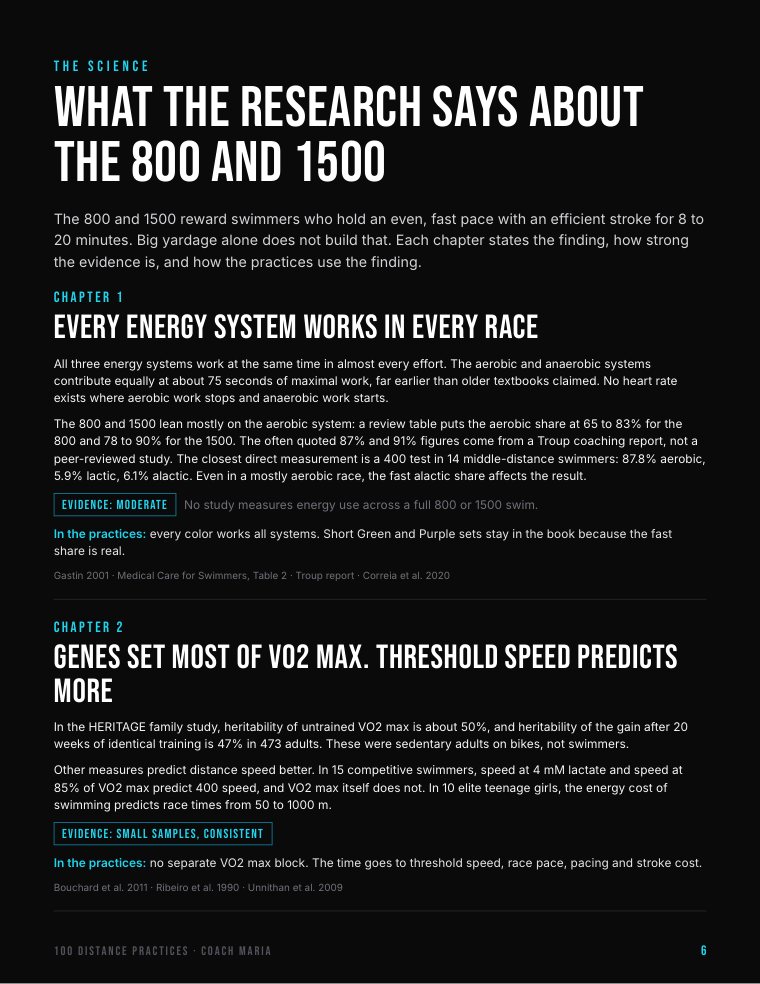 Page 6
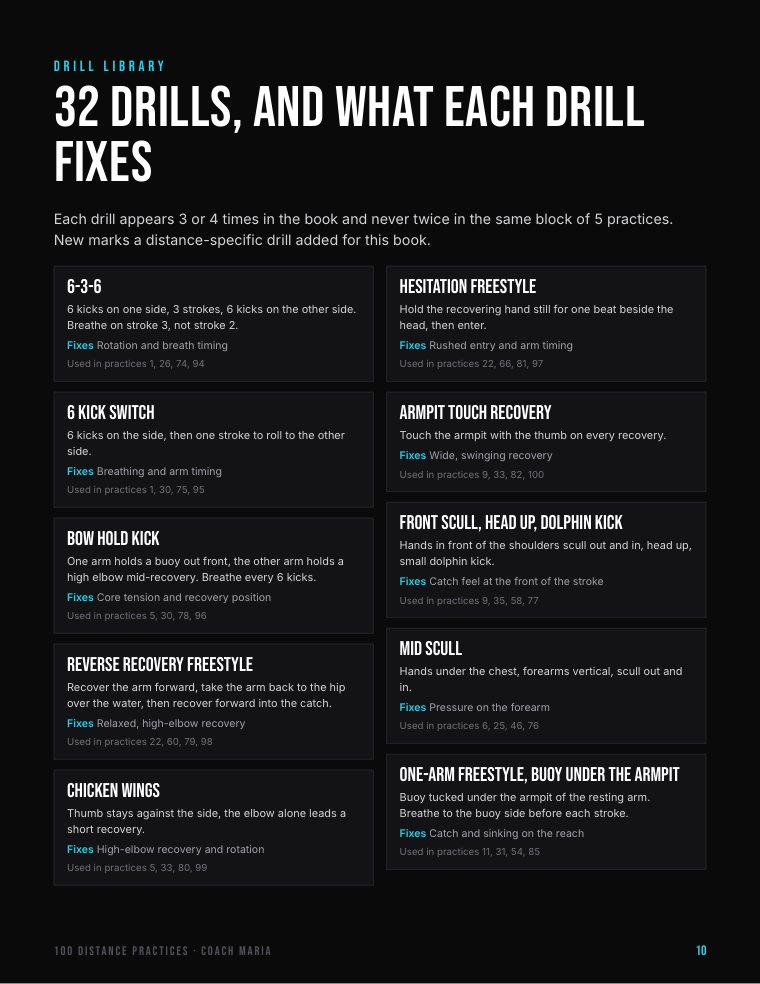 Page 10
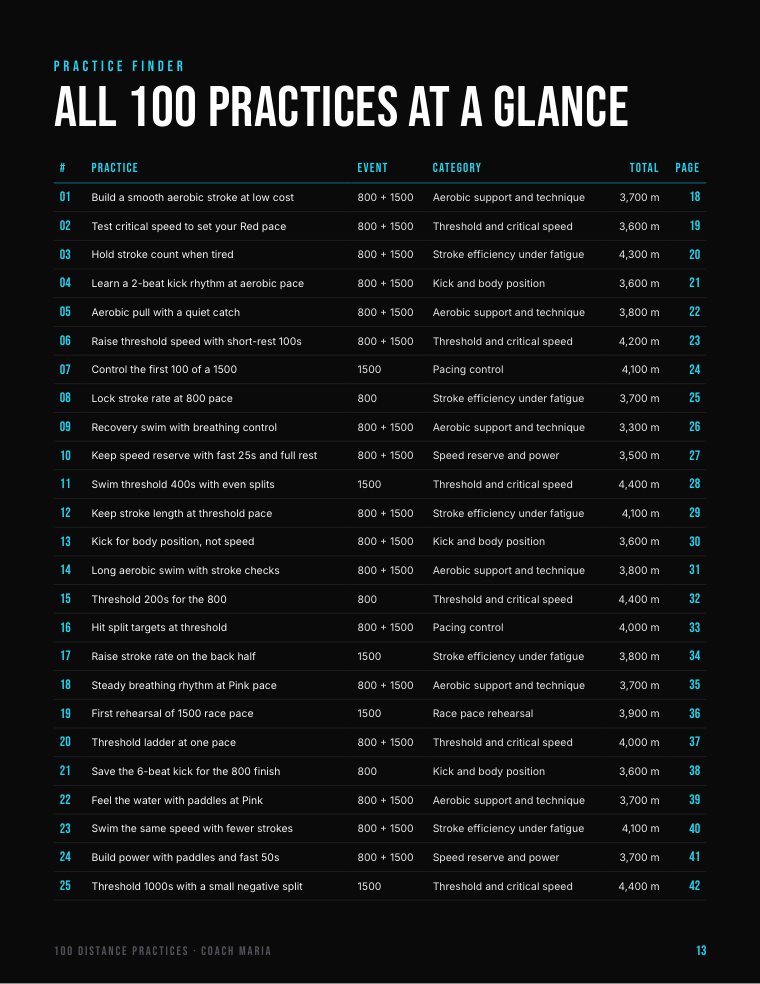 Page 13
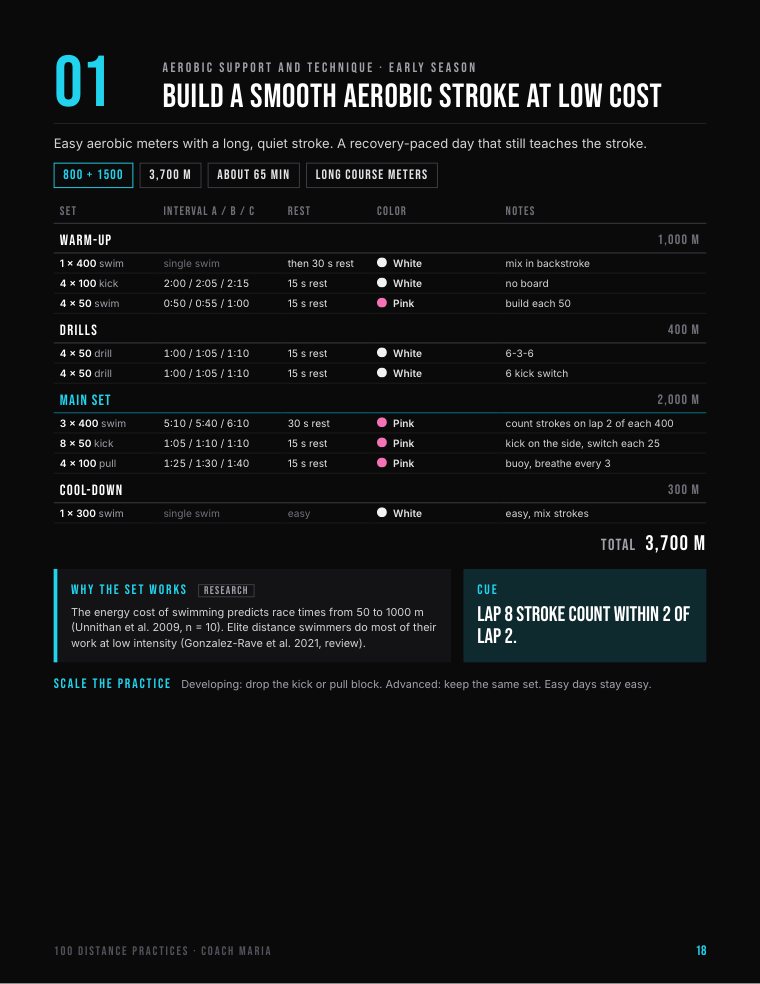 Page 18
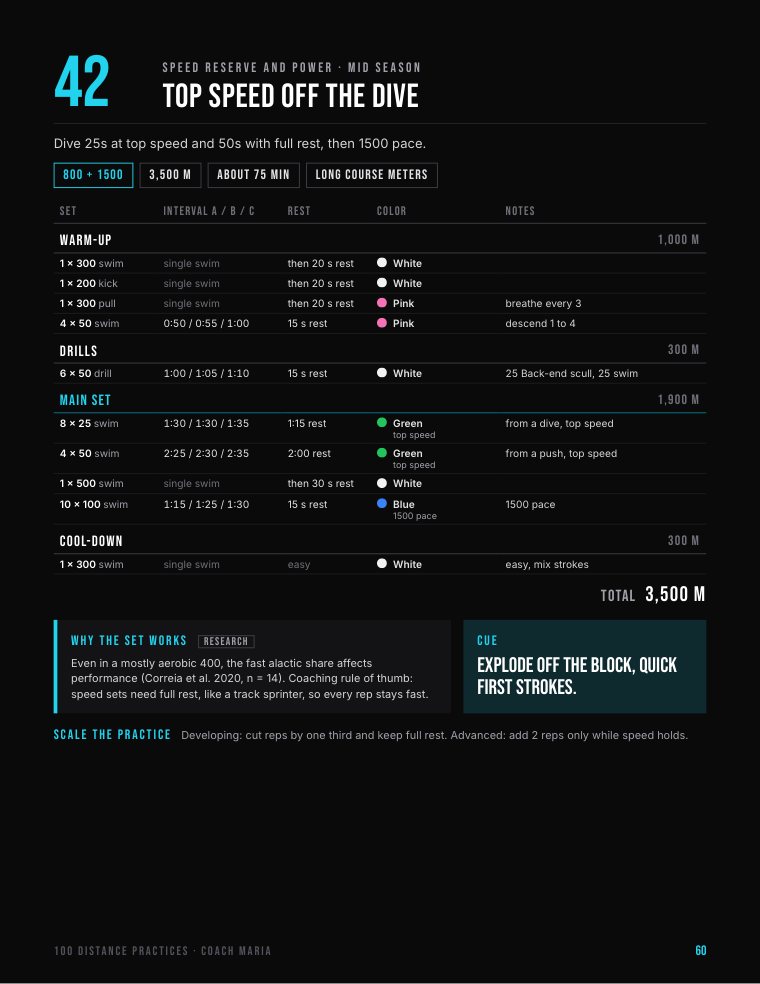 Page 60
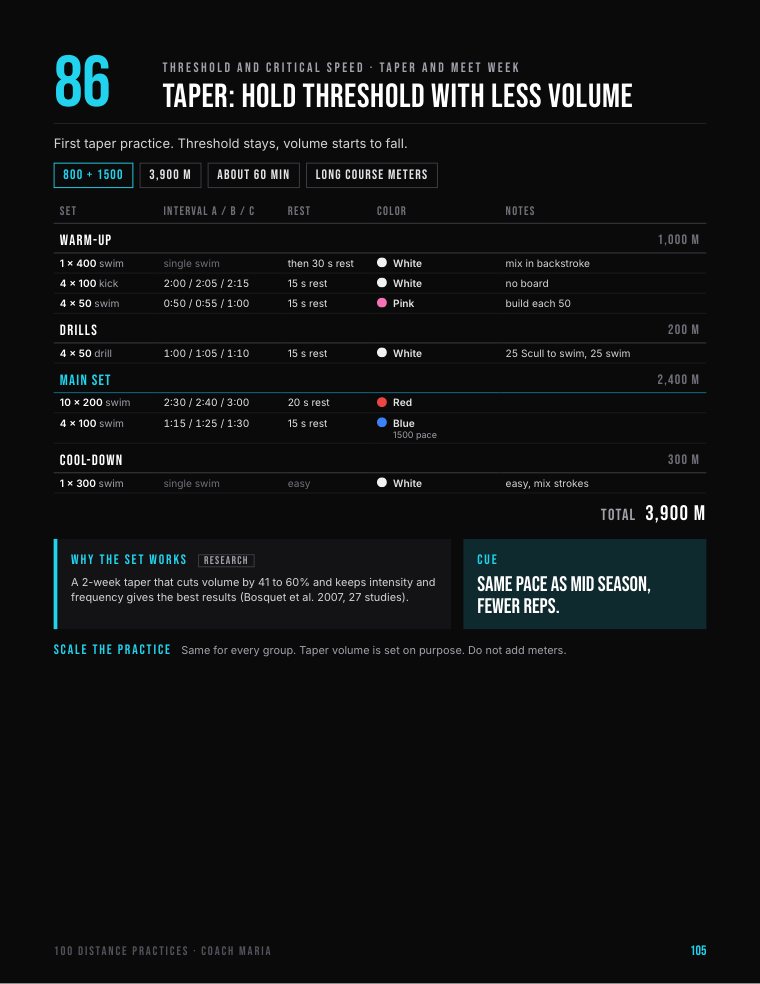 Page 105
Straight from page 60 · Practice 42 of 100
Top speed off the dive
- Warm-up300 swim, 200 kick, 300 pull breathing every 3, each with 20 s rest. 4 × 50 swim at Pink, descend 1 to 4, on 0:50 / 0:55 / 1:00.1,000
- Drills6 × 50 on 1:00 / 1:05 / 1:10: 25 back-end scull, 25 swim.300
- Main set8 × 25 from a dive at top speed on 1:30 / 1:30 / 1:35, 1:15 rest. 4 × 50 from a push at top speed on 2:25 / 2:30 / 2:35, 2:00 rest. 500 easy. 10 × 100 at 1500 pace on 1:15 / 1:25 / 1:30, 15 s rest.1,900
- Cool-down300 easy, mix strokes.300
Why the set works: even in a mostly aerobic 400, the fast alactic share affects the result (Correia et al. 2020). Speed sets get full rest, like a track sprinter, so every rep stays fast. Scaling: developing swimmers cut the reps by a third and keep the full rest; advanced swimmers add two reps only while the speed holds.
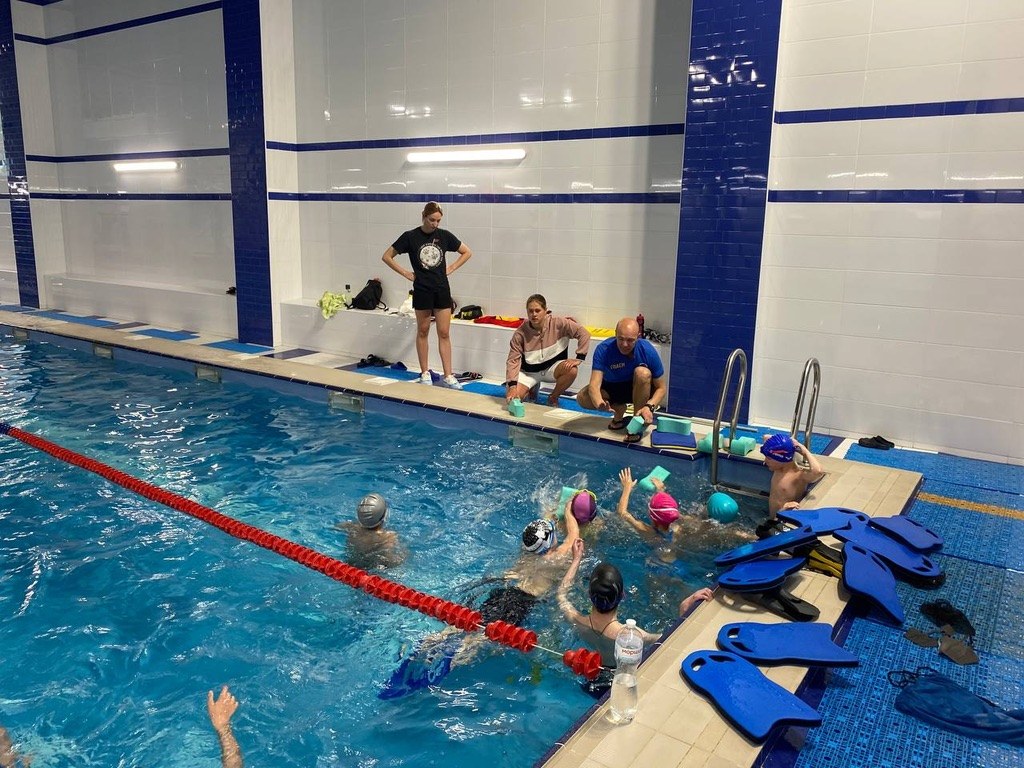
Written by the coach who swam it
Garbage yardage is not a plan. Every set has a job.
As an age grouper I swam about 70,000 meters a week. Today I call that volume unnecessary. The research agrees: more meters do not mean more speed, and no study finds that garbage volume helps. I hold the deaf world record in the 50 m breaststroke, swam twice as an NCAA All-American and coached a world championships medalist. This is the distance plan I wish I had: the least work that still makes you faster, with the reason on every page.
Coach Maria Rezhylo · founder, Fast Swim Academy, Tampa
What you get
- 100 practices in three blocksEarly season, mid season, taper and meet week. Typical practices run 3,400 to 4,500 meters and 60 to 75 minutes, with a hard cap of 6,500.
- Every pace from your goal timeA pace key turns your goal 800 or 1500 into 1500 pace, 800 pace, Red, Pink and White. Three pace groups, and three intervals printed on every set.
- Tagged for your race27 practices written for the 800 alone, 34 for the 1500, 39 for both. Short on sessions? Skip the other event first.
- The research on every pageEight science chapters and 31 sources. Every main set is tied to a study or labeled a coaching rule of thumb, with how strong the evidence is.
- Pacing as a skillSplit targets, called splits, start control, even middle laps and the end spurt, plus six race simulations from a dive.
- Taper and meet week, written outPractices 86 to 100: volume falls from about 4,000 to about 2,600 meters, race pace stays, and the last two days are planned.
- A 32-drill libraryWhat each drill fixes and the practices that use it. Each drill appears three or four times across the season.
- Yours to keep120-page PDF. Download it right after paying, and again from your email. Phone, tablet or laptop, or print the practice of the day for the deck.
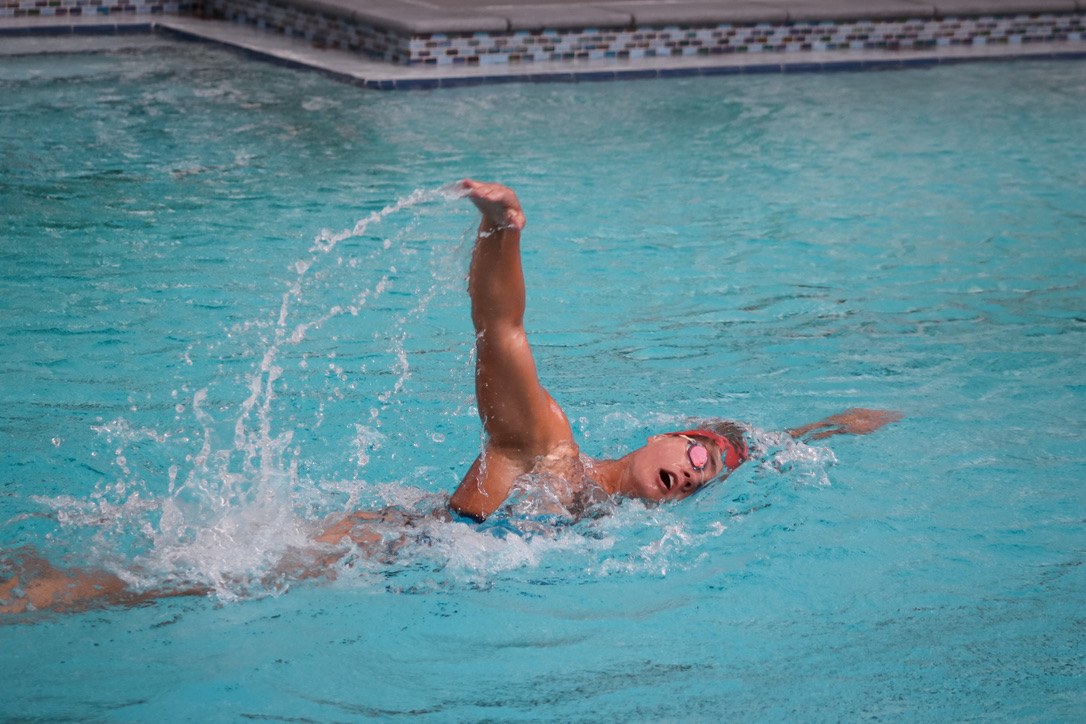
Written by Coach Maria Rezhylo
- Deaf world record holder, 50 m breaststroke
- European and world deaf champion
- 2x NCAA All-American, then professional swimmer
- Coached an athlete to a world championships medal
- Degree in Exercise Science, biomechanics
- Founder of Fast Swim Academy, Tampa Bay
Pacing is a skill. Rehearse race pace often, so the brain accepts that speed as safe, and learn not to go out too fast or too slow.
Checkout
Get the practices
Add another book, 20% off each
Every book comes as its own PDF with its own link, in one email.
Already paid and lost the link? Send it to me again
Questions before you buy
Who is this for?
Swimmers who race the 800 or the 1500 freestyle: age groupers from about 13, club and college distance swimmers, masters who race the mile, and the coaches who write their weeks. Three pace groups cover a 1500 from about 14:45 to 20:00, and anyone faster or slower builds their own interval from the stated rest.
Which race, the 800 or the 1500?
Both. Every practice is tagged 800, 1500 or both, and the pace key sets a separate 800 pace and 1500 pace from your goal times. Short on sessions, skip the practices tagged for the race you are not swimming.
Meters or yards?
The book is written in long course meters, and every interval comes from your goal time rather than a fixed clock. In a short course pool, set your paces from a goal time for that pool and swim the same numbers. The rest on each set does not change.
How do I find my paces?
Page 4. Divide your goal 1500 by 15 for 1500 pace per 100, your goal 800 by 8 for 800 pace, and add 2 to 4 seconds for Red, your threshold pace. Practice 2 tests your critical speed from a 400 and a 200 and gives you a starting Red pace and your pace group.
How long is a practice?
Most are 3,400 to 4,500 meters and 60 to 75 minutes. Recovery days are shorter, nothing passes 6,500, and the taper falls to about 2,600 meters. The total and the time are printed on every page.
What equipment do I need?
A pace clock, a pull buoy, paddles and a kickboard. Some practices use fins or a tempo trainer. No set in the book uses breath holding.
I have a meet in a few weeks. Where do I start?
Practices 86 to 100 are the last two weeks before a meet, with the volume already falling. Swim practice 2 first so your paces are real, then go straight to the taper block.
I coach a team. Can I run it with my swimmers?
Yes, the book is for personal and team use. Group your lanes by pace group, give each lane its interval, and run the sets as written. Please do not resell or share the file itself.
How do I get the book?
It is a 120-page PDF. The download button appears right after payment, and the same link goes to your email. It opens on a phone, tablet or laptop, and each practice prints on one page for the deck. The link works for a year. Lost it? Use the resend link under the checkout.
Is this a subscription?
No. One payment, the book is yours. It is $29 until Nov 14, then $39.
Something went wrong with my order
Reply to the email or text Maria at (475) 223-9849. A real person answers.