In this guide · 10 parts
- 01What is the correct freestyle technique?
- 02How do you breathe without slowing down?
- 03Why do your hips sink, and what does the kick do?
- 04How much should you rotate?
- 05What is the catch in freestyle?
- 06Should your arms catch up or overlap in freestyle?
- 07Stroke rate or stroke length: which makes you faster?
- 08What is the hardest technique in freestyle?
- 09Which drills fix which freestyle faults?
- 10How do you check your own freestyle stroke?
- QQuestions swimmers ask
- ●Sources
What is the correct freestyle technique?
Correct freestyle keeps you long and level, takes each breath on the roll and catches the water with your forearm. Your arms make most of the speed. Your kick adds push and keeps your hips up, so the arms pull from a level body.
The parts depend on each other. The table lists each one, what good looks like, and the fault that shows up when it goes wrong.
Body line
- What good looks like
- Long from toes to fingertips, hips near the surface
- Common fault
- Hips and legs ride low, and you feel like you swim uphill
Breathing
- What good looks like
- Your body turns and your head comes with it, one goggle in the water
- Common fault
- Your head lifts forward, and you swallow water or gasp
Kick
- What good looks like
- Starts at the hip, steady, toes pointed
- Common fault
- Bends from the knee and splashes
Rotation
- What good looks like
- Your body rolls around a still head
- Common fault
- You swim flat and your shoulders reach around a flat body
Catch and pull
- What good looks like
- Forearm set early, elbow above the hand, water pushed back
- Common fault
- Straight arm, so the hand slips or pushes water down
Recovery
- What good looks like
- Elbow leads, hand close and relaxed, entry in front of the shoulder
- Common fault
- Arm swings wide and stiff, and the hand slaps in
Timing
- What good looks like
- At easy pace the lead arm stays long until the other hand enters
- Common fault
- The front arm pulls early, and your arms feel like they spin
Which fault do you fix first?
I teach a fixed order: breathing first, then body position, then the catch. Breathing breaks body position, and body position breaks the catch. Fix them in that order and each fix has a stable base.
No study in the research behind this guide tests that teaching order, so treat it as my coaching judgment. The research does show that breathing changes the stroke. Swimmers roll further to breathe, and breathing made short sprints slower.
How do you breathe without slowing down?
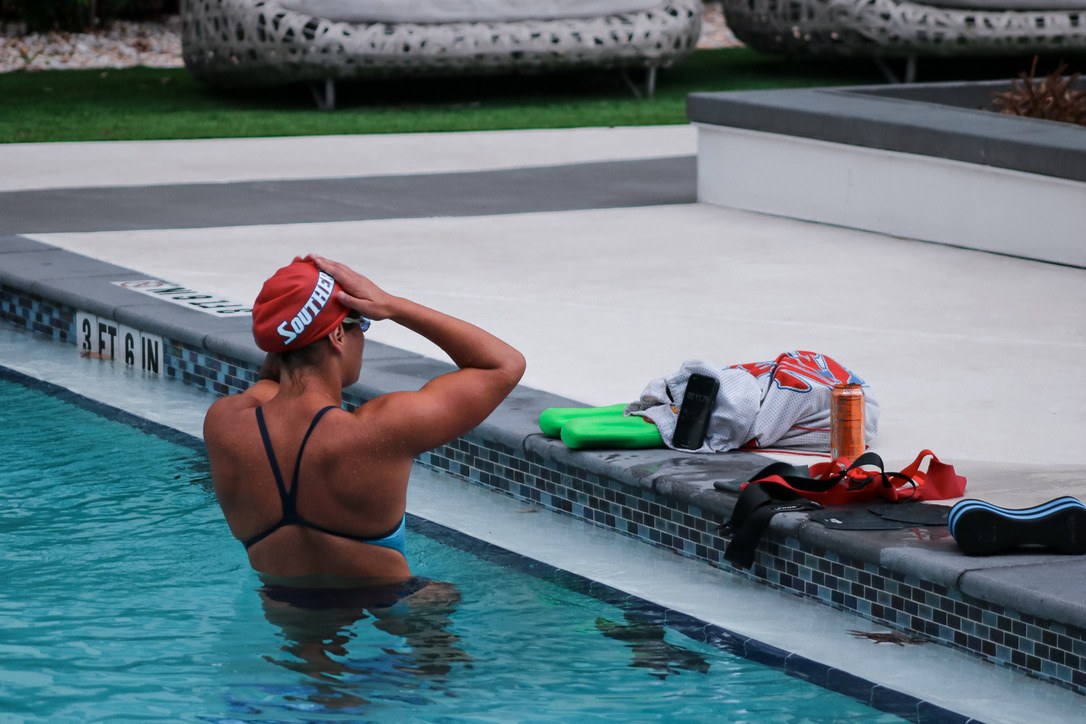
Turn your body to breathe and let your head come with it, one goggle still in the water. Breathe out with your face down, so the turn is for the inhale alone.
Breathing has a cost. In 10 male swimmers, breathing made 25 m (27 yd) sprints 3% slower than holding the breath McCabe 2015. If you race the 50, weigh that 3% when you plan your breaths.
At 200 m (219 yd) race pace the picture is different. Six male swimmers rolled 66 degrees on breathing strokes and 57 degrees without a breath, and they kept their stroke length Payton 1999.
Those swimmers found their air with about 9 extra degrees of roll, and the stroke did not shrink. Neither study measured head lift. "Turn, don't lift" is my coaching cue, built on that result.
The cues
- One goggle stays in the water and one comes out. Your ear stays on the surface. If both eyes clear the water, you lifted too far.
- Look at the side wall. The pocket of air is already beside your face.
- Blow out the whole time your face is down. Hum so you can hear it, and empty your lungs before you turn.
- Take a quick sip of air. A big gulp opens your mouth wide and breaks your neck position.
- Keep the lead arm long. If it presses down to lift your mouth, your hips drop.
- Turn as your hand exits at your hip. Get your face back down before that hand enters in front.
If the breath feels frantic, slow the whole stroke down until the breath fits the rhythm. Breathe out earlier, and the inhale stops feeling rushed.
The free guide Breathe Without Lifting Your Head takes you from the wall to full stroke in six drills, with videos.
FreeGoes with this article
10 Drills to Fix Your Freestyle Catch
- Ten catch drills, in order
- A set, a cue and the most common mistake for each
- A four-week plan
- 10 drills
- 4-week plan
Free. Leave your name and email and the PDF is yours.
Why do your hips sink, and what does the kick do?
Your hips sink when your head lifts or your front arm presses down, because your body works like a seesaw. The kick pushes you forward, and it also holds your legs up, which cuts drag.
On a tether, the arms gave 70% of the force in male swimmers and 67% in female swimmers Morouço 2015. That study tested 23 national-level youth swimmers. The legs gave the rest, near 30%.
Some popular guides put the legs at 10% to 15% of propulsion and cite nothing. The tethered data put them about twice as high. A tether is not free swimming, so read the numbers as a rough share.
The kick has a second job: posture. In 9 female sprinters, kicking cut trunk inclination by 13% without changing the forces on the hands Gourgoulis 2014. Trunk inclination is the tilt of your body, hips lower than shoulders, and less tilt means less drag.
How to keep your hips up
- Keep your head neutral, eyes on the bottom of the pool.
- Keep the front arm long and near the surface. Reach forward, not down.
- Kick from the hips. A kick from the knees splashes and moves you little.
- Hold your core tight so your legs follow your chest.
Try a buoy test. Swim one length with a pull buoy and one without, at the same easy effort. If the buoy makes you much faster, your legs are sinking.
How much should you rotate?
Roll enough to breathe low and let your recovering shoulder clear the water, with your body turning around a still head. Skip the hunt for a target angle: faster swimmers in the research rolled their shoulders less.
A review of body roll research found that the shoulders roll more than the hips Psycharakis 2010. Faster swimmers rolled their shoulders less over 200 m. Buoyancy drives much of the roll.
You may read that top freestylers rotate about 30 degrees. That figure comes with no source. Measured roll at 200 m pace was 57 degrees without a breath and 66 degrees with one Payton 1999.
My coaching judgment from this: let the roll come from the stroke and your hips. Turn your head and hips together, and stop forcing extra rotation.
Too flat or too much?
- Too flat: you press down on the water to breathe, or your shoulders get sore.
- Too much: on a pull set with a kickboard between your thighs, the top of the board breaks the surface. A small tilt each stroke is enough.
- Head leading: your head swings side to side or turns before your body does.
What is the catch in freestyle?
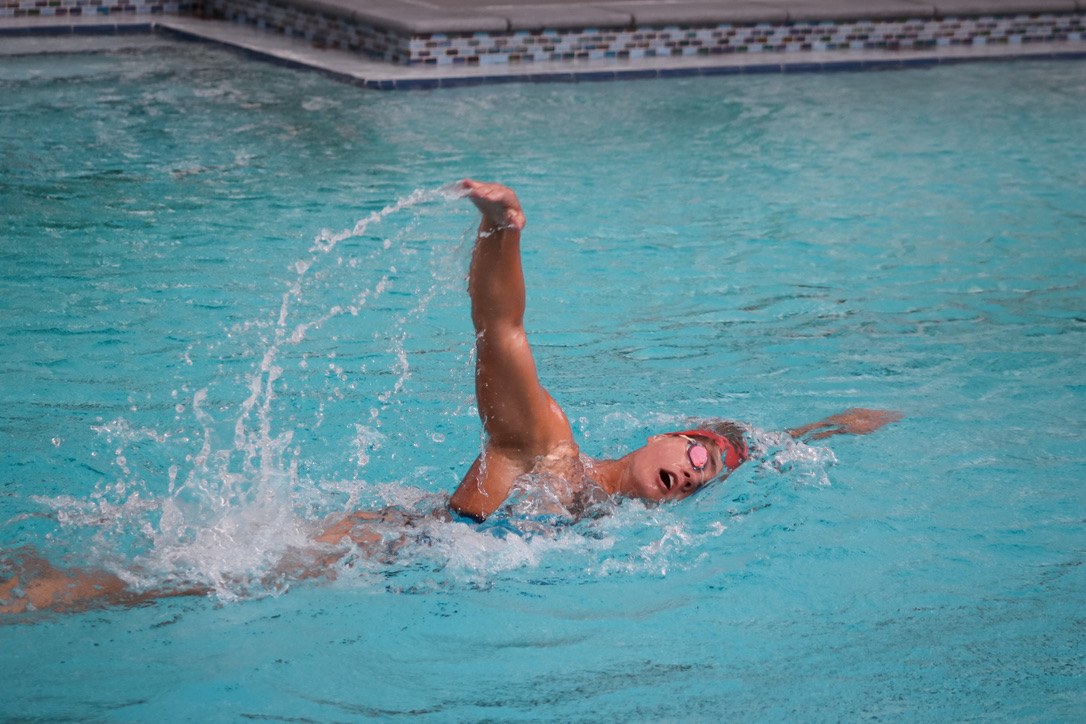
The catch is the start of the pull, out in front. You set your forearm against the water with the elbow above the hand. Your forearm is a much bigger paddle than your hand, and it works only while the elbow stays high.
Drop the elbow and your hand pushes water down instead of back. You feel no pressure, the hand slips, and you take many strokes for little distance.
The arms give about two thirds of your force on a tether, so the catch decides how much of that force goes backward. Set the forearm first, then follow the pressure back to your hip.
The cues
- Reach long, then set the forearm before you pull.
- Keep the elbow above the hand.
- Push the water back toward your feet.
- Feel pressure on your forearm and the back of your hand.
The free 10 Drills to Fix Your Freestyle Catch gives each drill a set, a cue and the most common mistake. It also has a four-week plan.
Start with front sculling, even if it feels too easy. The other drills build on it.
Should your arms catch up or overlap in freestyle?
It depends on your pace. At distance pace a short gap between the arms is normal. At sprint pace the gap closes, and the best swimmers in the research overlapped at 50 m (55 yd) pace.
One study measured arm timing in 43 swimmers at three levels Chollet 2000. It used an index of coordination: a negative score means a gap between the two arms' pulls, a positive score means overlap.
800 m (875 yd) pace
50 m pace
50 m pace, best group
See the numbers
| Pace | Average index of coordination |
|---|---|
| 800 m (875 yd) pace | -7.6% (a gap) |
| 50 m pace | -0.9% (close to no gap) |
| 50 m pace, best group | +2.53% (overlap) |
In my course drills, the lead arm waits out front until the recovering hand enters. I teach that as timing for easy and distance swimming. At easy pace, a front arm that pulls early leaves you with no arm out front, and the stroke feels like spinning.
At sprint pace I would not force the wait. The research shows the gap closing as speed rises, so let your arms move toward overlap in a 50. This is my coaching judgment from one study of 43 swimmers, and that study did not test it as a teaching rule.
How to practise both
- Swim catch-up drill at slow pace, 4 x 50 (yards or metres), to learn the patient lead arm.
- Swim easy freestyle and keep an arm out front at all times.
- Swim a few 25s at 50 pace and let the arms speed up and close the gap.
- Film one easy length and one fast length from the same spot, and compare the timing.
Stroke rate or stroke length: which makes you faster?
You need both. Faster swimmers take longer strokes, but race speed also depends on stroke rate, so track both numbers.
Your speed is your stroke rate times the distance you travel on each stroke. In race analysis, Olympic Trials finalists had longer strokes than swimmers 3% to 7% slower, in almost all events Craig 1985.
Rate matters too. In elite 50 m races, 181 male swimmers did not always hit top section speed with the highest rate or longest stroke Morais 2023. They found speed in the mix of the two.
My course uses fewer strokes per length at the same easy effort as the proof of a better stroke. The research backs that in part. For fitness swimmers and triathletes it is a good check, and if you race, add the clock.
How to track it
- Swim one length at easy effort and count each hand entry.
- Time the same length, push-off to wall.
- Use the same pool each time. A 25 yd pool and a 25 m pool give different counts.
- Read the pair. A lower count with the same or a faster time means a better stroke. A lower count with a slower time means you traded rate for length.
What is the hardest technique in freestyle?
Breathing is the hardest freestyle skill to get right, in my coaching judgment. It has to fit one window in the stroke, and it moves your roll, your head and your lead arm.
The window is short. Turn as your hand exits at your hip, and get your face back down before that hand enters in front. Miss it, and you chase air for the rest of the length.
The research shows how much the breath touches. Swimmers rolled about 9 degrees further on breathing strokes Payton 1999. Breathing also made 25 m (27 yd) sprints 3% slower McCabe 2015.
A late exhale makes it harder still. You try to breathe out and in during one short turn, come up short of air, and lift your head higher next time. Breathe out the whole time your face is down, and the turn has room for the inhale.
For faster swimmers the hard part moves to the catch at race speed. A forearm catch that holds at easy pace can fall apart at 50 pace. Water polo freestyle, 6 x 25 fast, from the catch drills, trains that.
Which drills fix which freestyle faults?
Match the drill to your fault, then carry it back into your stroke. After each drill length, swim one length of slow freestyle, so the feeling moves into your swimming.
Tap the ones that sound like you.
Head lifts to breathe
- You notice
- You swallow water or gasp
- Drill
- Breathing at the wall, two hands, face down
- Cue
- Turn with your shoulders, not your neck
Hips drop on the breath
- You notice
- Your legs sink as you turn
- Drill
- Kick on your side with a buoy
- Cue
- Keep the lead arm long
Rushed breath
- You notice
- Your stroke speeds up and shortens on the breath
- Drill
- 6-3-6: six kicks on your side, three strokes, six kicks
- Cue
- Hold the line through the kicks
Legs sink
- You notice
- A buoy makes you much faster
- Drill
- L hold kick: one arm up, one long in front
- Cue
- Kick from the hips
Flat body
- You notice
- Sore shoulders, pressing down to breathe
- Drill
- Pull with a kickboard between the thighs
- Cue
- A small tilt each stroke
Hand slips
- You notice
- Many strokes, little distance
- Drill
- Doggy paddle
- Cue
- Push back, not down
No feel for the water
- You notice
- No pressure on the forearm
- Drill
- Front sculling
- Cue
- Small sweeps, elbows high
Wide, stiff recovery
- You notice
- Your hand slaps in and your hips swing
- Drill
- Chicken wings: thumb drags up your side
- Cue
- The elbow leads, the hand follows
Front arm pulls early
- You notice
- Your arms spin and you lose the glide
- Drill
- Catch-up drill
- Cue
- The lead arm waits out front
Catch fails at speed
- You notice
- Your stroke falls apart in fast 25s
- Drill
- Water polo freestyle
- Cue
- Catch first, then pull
The drills run in 25s, so they work in a 25 yd or a 25 m pool.
How to use them
- Pick one drill for your biggest fault.
- Swim four lengths of it before your main set.
- Stay with it for a week.
- Move on when it feels easy, not when you get bored.
The first three drills are in the free breathing guide. Doggy paddle, front sculling, catch-up and water polo freestyle are in the free catch drills.
If you want every fault in order, Fix Your Freestyle starts with a two-minute self-check that picks your two problems. It then gives you 45 video lessons and a personal 6-week plan, with a test that tells you when to move on.
How do you check your own freestyle stroke?
Film one length from the side and count your strokes. Six weeks later, repeat the same test at the same easy effort, and compare the clips and the counts.
Film from the side, underwater if you can, at the same spot each time. Watch the clip slowed down, one part of the stroke at a time.
What to look for on the video
- On the breath, does one goggle stay in the water, or does your head lift forward?
- On the breath, does your lead arm stay long, or press down?
- Are your hips near the surface?
- As the pull starts, is your elbow above your hand?
- Does the elbow lead the recovery, and does the hand enter in front of the shoulder?
- At easy pace, do you always have an arm out front?
Checks without a camera
- You gasp at the wall: you held your breath somewhere. Blow out the whole time your face is down.
- Your neck is sore after a set: you turned your neck instead of your body.
- A buoy makes you much faster: your legs sink.
- Your shoulders are sore: check for a flat body or a wide, stiff recovery.
If you race, film one length at easy pace and one at 50 pace from the same spot. Compare the breath and the arm timing between the clips, and log stroke count and time for both.
Questions swimmers ask
What is the correct freestyle technique?
Lie long and level, head still, eyes on the bottom. Breathe by turning your body until one goggle clears the water, and breathe out with your face down.
Set your forearm early, elbow above the hand, then push the water back to your hip. Kick from the hips to hold your legs up. Recover with a high, relaxed elbow.
Keep an arm out front at easy pace, and let the arms overlap more at sprint pace.
What are the 5 basic skills of swimming?
Lists differ by coach. For freestyle I teach five: breathing, body position, the kick, the catch and pull, and timing. Breathing comes first, because it moves your head and your roll, and those set your body position.
The catch and timing come once you can breathe without your hips dropping. That order is my coaching judgment; the research behind this guide has not tested it as a teaching order.
What is the hardest technique in swimming?
In freestyle, I rate breathing as the hardest skill. It must fit one window: turn as your hand exits at your hip, and face down before that hand enters again.
In the research, swimmers rolled about 9 degrees further to breathe, and breathing made 25 m (27 yd) sprints 3% slower.
For fast swimmers, the next hardest skill is holding the catch at race speed.
Freestyle technique help, please: where do I start?
Start with your breath. If you lift your head, swallow water or gasp at the wall, fix that first with the breathing drills. Then do the buoy test: if a pull buoy makes you much faster, work on your hips and kick.
Then work on the catch. Film one length from the side and count your strokes before you start, so you have a before picture.
The next step
Fix Your Freestyle
The freestyle technique course: a two-minute diagnosis, 45 video lessons in the right order, and a personal 6-week plan.
See Fix Your FreestyleSources
- Morouço 2015, relative contribution of arms and legs in tethered front crawl, PubMedPubMed
- Gourgoulis 2014, effect of the kick on trunk inclination and hand forces in sprint front crawl, PubMedPubMed
- McCabe 2015, effect of breathing on 25 m front crawl sprint performance, PubMedPubMed
- Payton 1999, breathing and body roll in front crawl at 200 m pace, PubMedPubMed
- Craig 1985, stroke rate and stroke length in Olympic Trials swimmers, PubMedPubMed
- Morais 2023, stroke rate, stroke length and section speed in elite 50 m freestyle, PubMedPubMed
- Chollet 2000, index of coordination in front crawl at different paces, PubMedPubMed
- Psycharakis 2010, review of body roll in front crawl swimming, PubMedPubMed