Fast Swim Academy · Dryland series
Shoulders that handle the yardage.
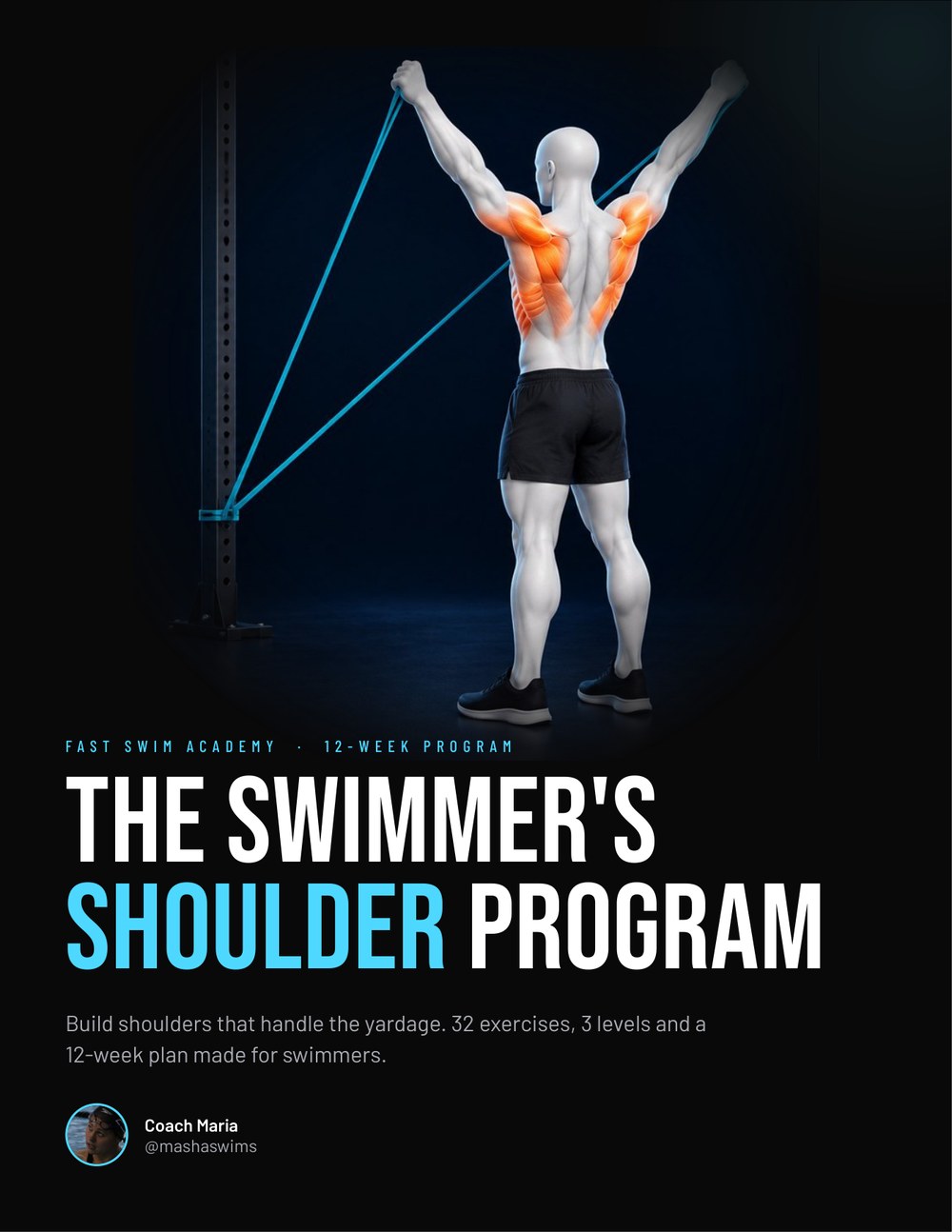
The rotator cuff, the shoulder blades and the back, trained in the positions your stroke uses. The exercises a physical therapist would hand you, with a pain rule built in. Twelve weeks, two sessions a week.
Price goes up to $19.99 on Oct 19.
Made for every swimmer
Whoever you are in the water, this is for you.
- BeginnersLevel 1 is bands and bodyweight. You learn the positions before anything gets heavy.
- Age group swimmersBuilt around a swim week: two short sessions after practice, lighter every fourth week and in meet weeks.
- Masters swimmersThe volume is lower, the years are higher. The rotator cuff and shoulder blade work is what keeps you in the water.
- Advanced swimmersLevel 3 goes to barbell rows, weighted push-ups and the overhead press, with a wall slide test before you earn it.
- Sore shouldersThese are the exercises a physical therapist would hand you anyway, with a pain rule built in and a clear list of when to get checked first.
Inside the book
Build bullet-proof shoulders for swimming.
Thirty-two exercises, each on its own page with start and finish photos, the dose, the cues I use on deck and the one mistake I see most. Then the 12-week program written out day by day, the 5-minute pool deck warm-up, and the stroke fixes for the five faults that load your shoulder.
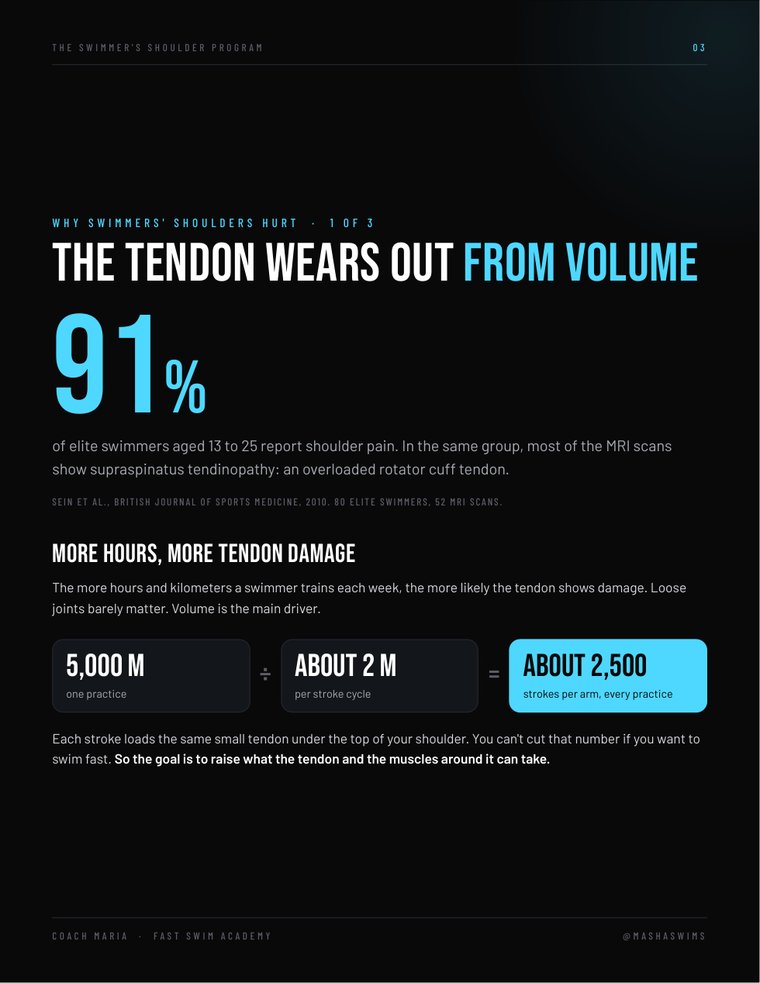 Page 3
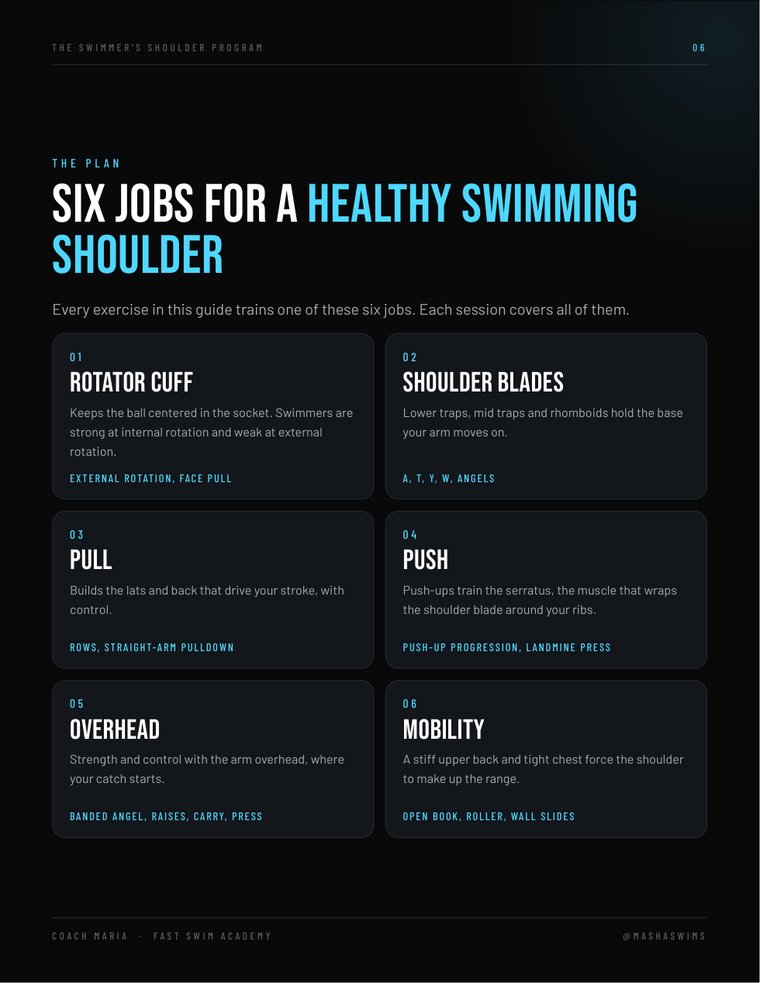 Page 6
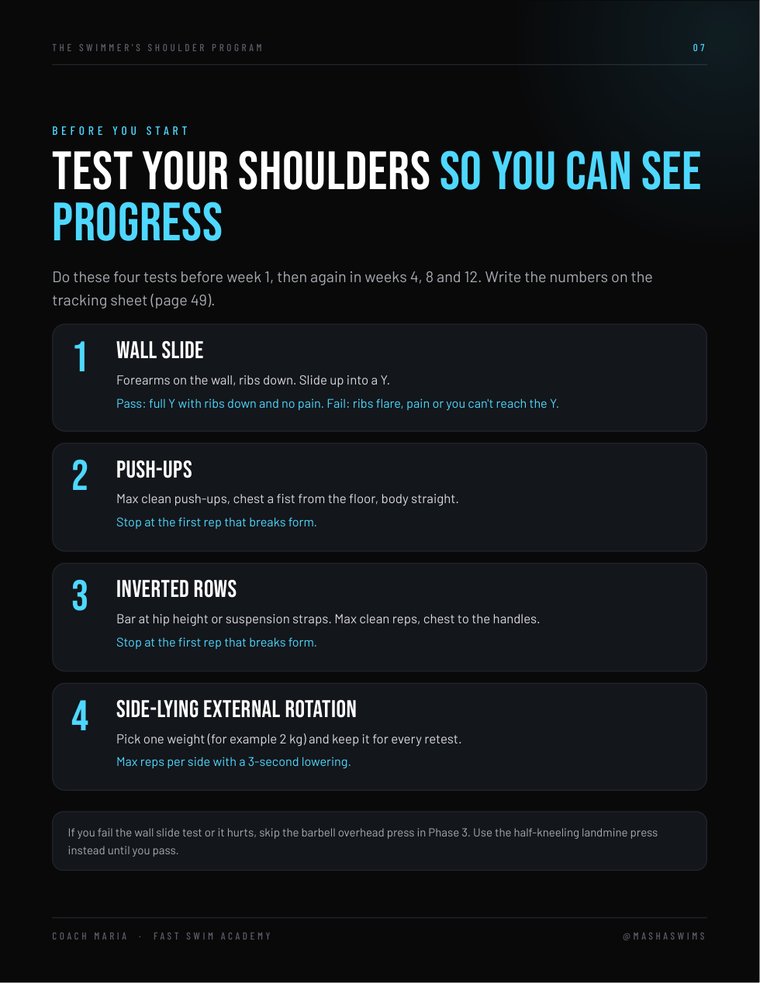 Page 7
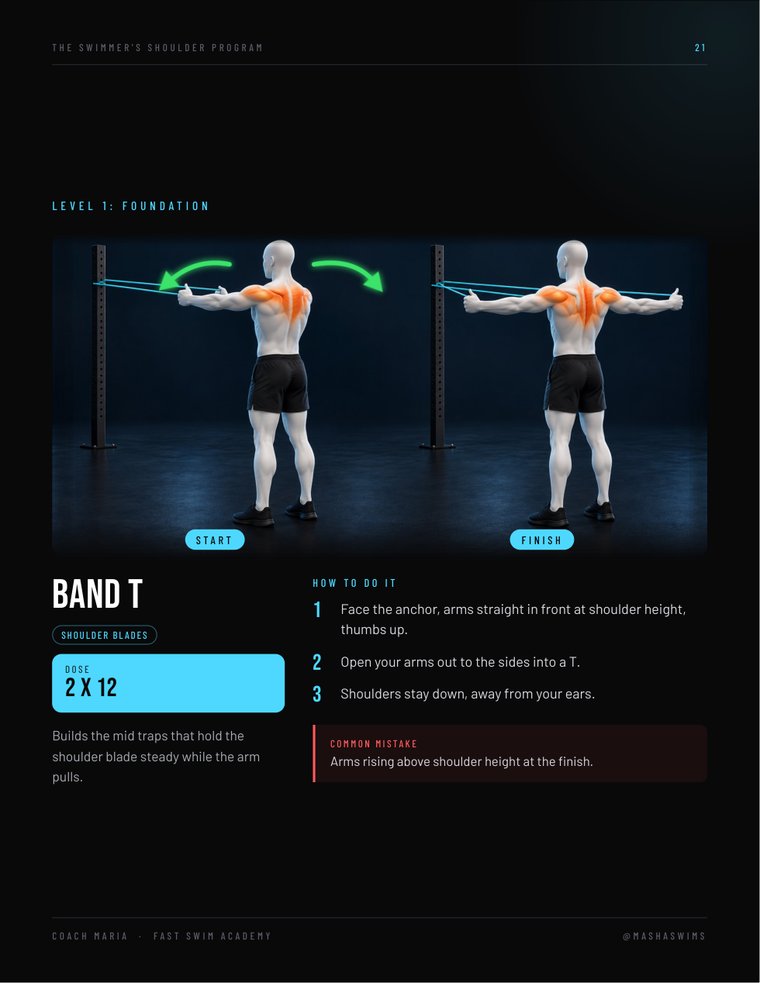 Page 21
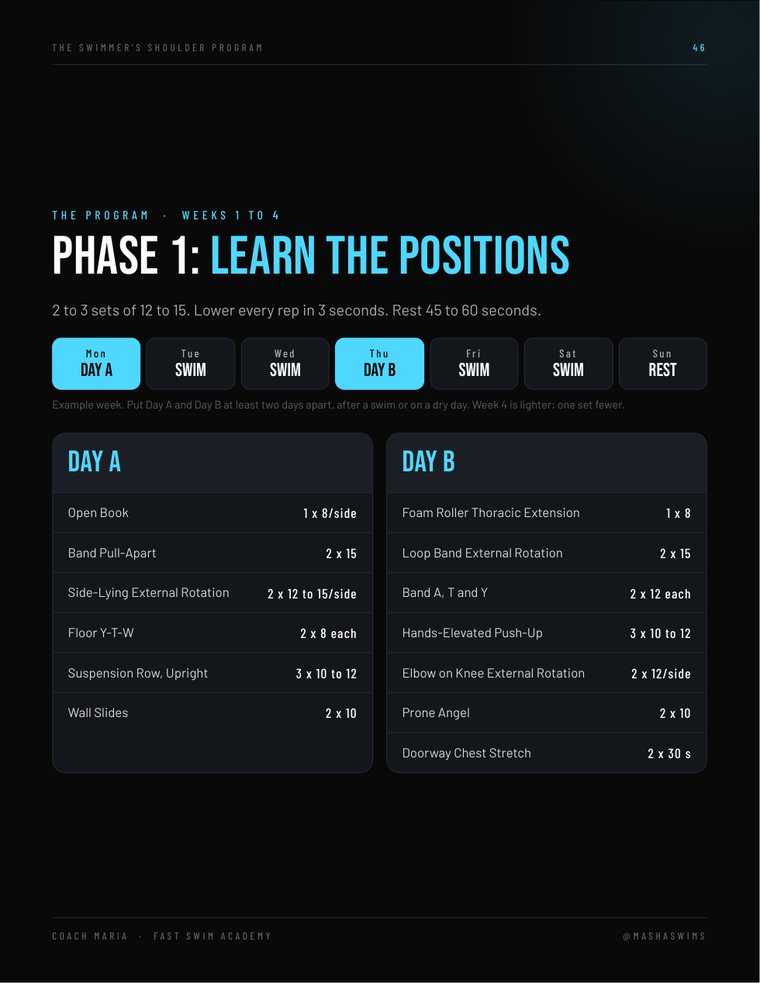 Page 46
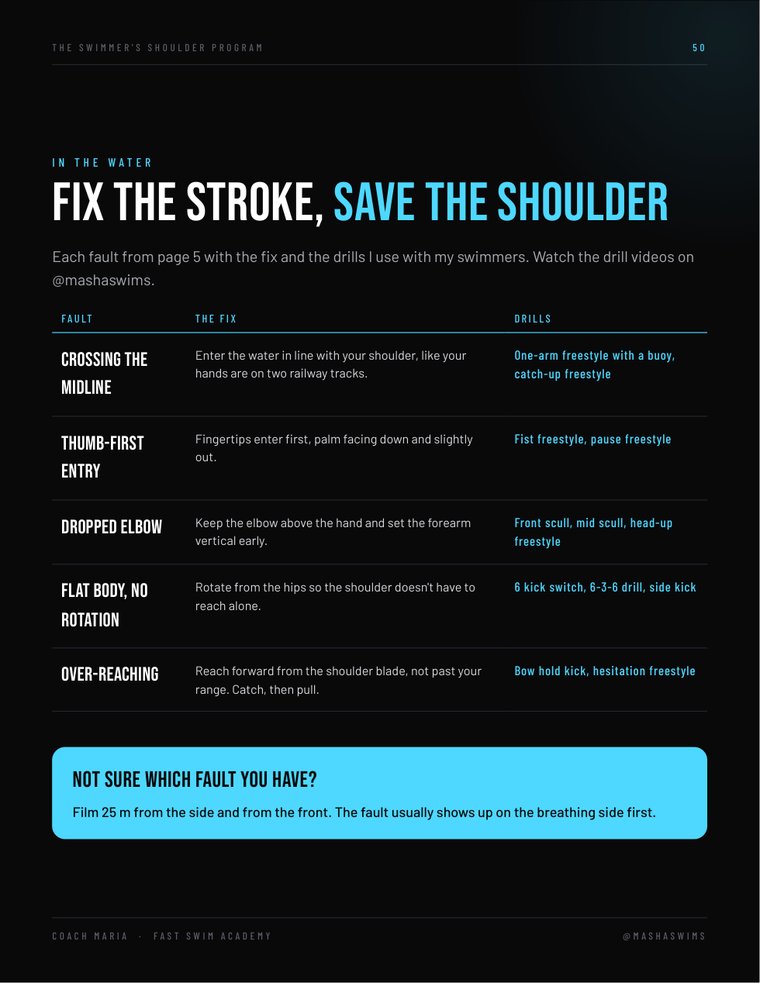 Page 50
Straight from page 46 · Day A, week 1
What a session looks like
- Open Book1 × 8 per side
- Band Pull-Apart2 × 15
- Side-Lying External Rotation2 × 12 to 15 per side
- Floor Y-T-W2 × 8 each
- Suspension Row, Upright3 × 10 to 12
- Wall Slides2 × 10
About 35 minutes, after practice or on a dry day. Every exercise has its own page with the cues, so you never guess.
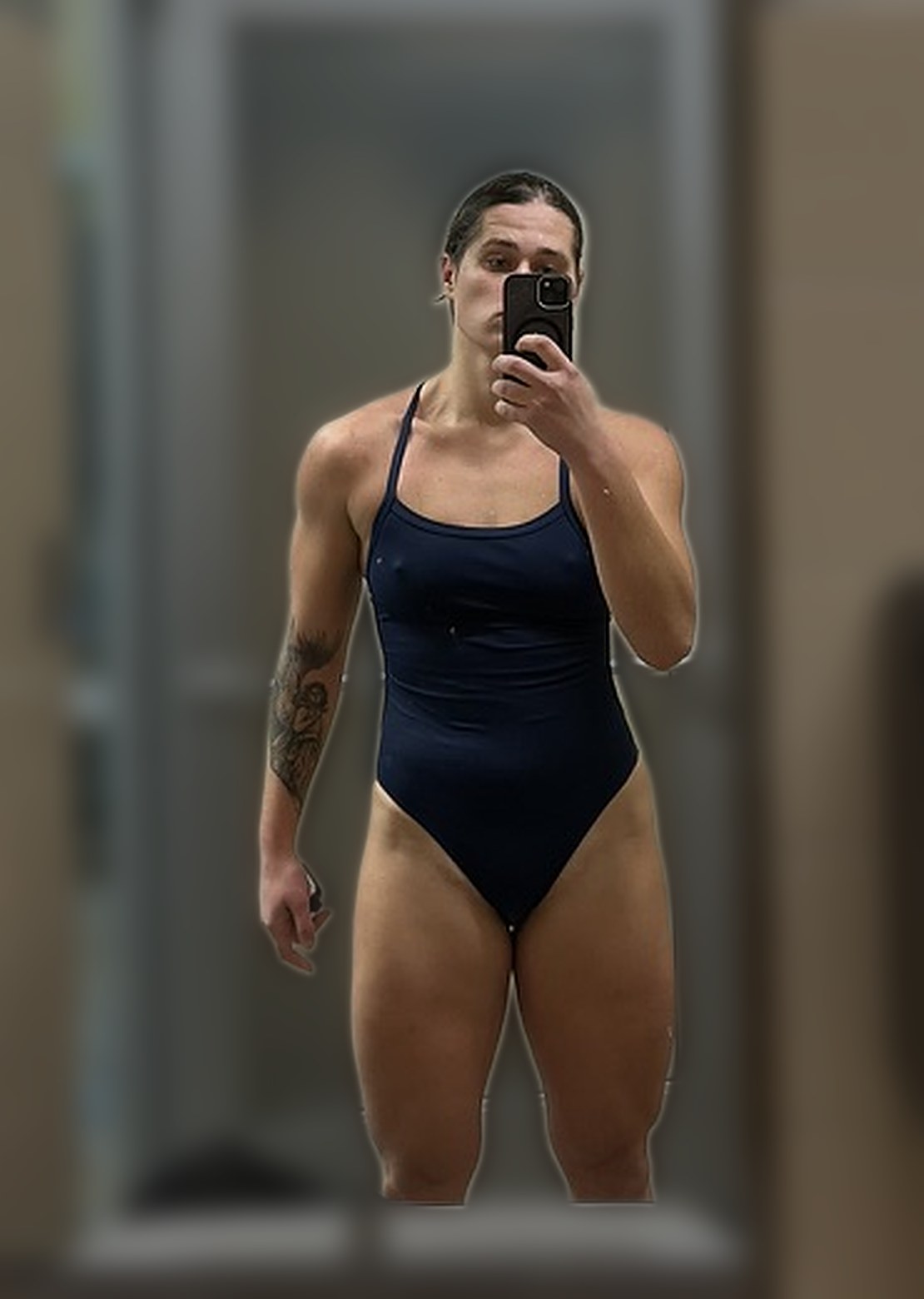
Written by the coach who swam it
The shoulder work behind a world record, two sessions a week after practice.
Deaf world record holder in the 50 m breaststroke, twice NCAA All-American, degree in biomechanics. Almost every swimmer I coach has had a sore shoulder. This is the program I give them: the muscles swimming leaves weak, trained in the positions your stroke uses, getting heavier as you get stronger.
Coach Maria Rezhylo · founder, Fast Swim Academy, Tampa
What you get
- The four self-testsWall slide, push-ups, inverted rows and side-lying external rotation before week 1. Retest at weeks 4, 8 and 12 so you see the numbers move.
- 32 exercises, one page eachSix jobs: rotator cuff, shoulder blades, pull, push, overhead and mobility. Start and finish positions, the dose, coaching cues, the common mistake.
- The 12-week program in three phasesLearn the positions, add load, get strong. Two sessions a week, 30 to 40 minutes, written out day by day with an example week around your swims.
- The 5-minute pool deck warm-upFour light band moves before every swim, so the rotator cuff is switched on before the first stroke.
- The five stroke faults that load your shoulderCrossing the midline, thumb-first entry, dropped elbow, no rotation, over-reaching. Each with the fix and the drills I use.
- The progress sheet and the pain scaleSelf-tests at weeks 0, 4, 8 and 12, sessions done, pain from 0 to 10, and the rule for when to drop back a level.
- Yours to keep52-page PDF. Download it right after paying, and again from your email. Phone, tablet or laptop.
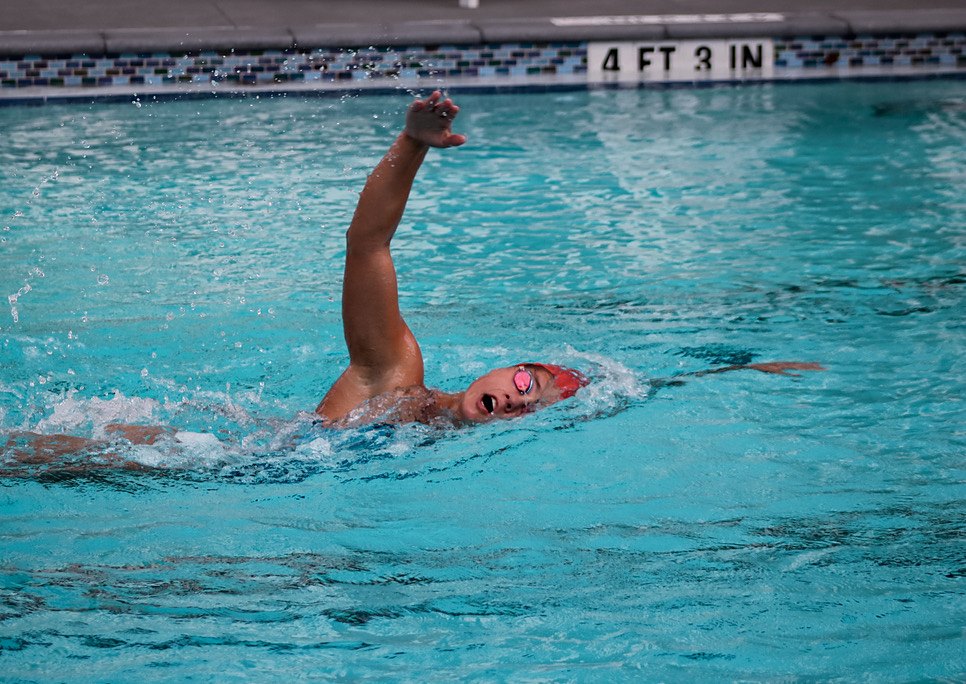
Written by Coach Maria Rezhylo
- Deaf world record holder, 50 m breaststroke
- European and world deaf champion
- 2x NCAA All-American, then professional swimmer
- Coached an athlete to a world championships medal
- Degree in Exercise Science, biomechanics
- Founder of Fast Swim Academy, Tampa Bay
Almost every swimmer I coach has had a sore shoulder. Most of them were told to rest, and the pain came back as soon as the yardage did. Rest lowers the load for a while. This program raises what your shoulder can handle.
Checkout
Get the guide
Add another book, 20% off each
Every book comes as its own PDF with its own link, in one email.
Already paid and lost the link? Send it to me again
Questions before you buy
Who is this for?
Any swimmer who wants shoulders that last: beginners, masters swimmers, triathletes and competitive swimmers. Three levels, from bands and bodyweight to barbells, so you start where you are.
If your shoulder hurts right now, read the safety page first and get it checked. Pain that wakes you at night, numbness down the arm, weakness, or a pop and a sudden sharp pain mean a physio or sports doctor before any program.
What equipment do I need?
Level 1 is bands and bodyweight: a loop band, a light long band, a foam roller and something to row on, like suspension straps or a bar at hip height. Level 2 adds light dumbbells and a cable or band anchor. Level 3 adds a barbell for inverted rows and the overhead press, and a landmine or a corner for the press.
How much time does it take?
Two sessions a week of 30 to 40 minutes, for 12 weeks in three phases. Plus the 5-minute warm-up on deck before every swim. Every fourth week is lighter, and you retest every four weeks.
When do I do it around swim practice?
The full sessions go after swimming or on dry days, at least two days apart. A tired rotator cuff cannot protect your shoulder in the water, so before a swim you do only the light 5-minute warm-up. In a taper or a meet week, one light session only.
My shoulder hurts a little. Can I still start?
The guide has a pain rule. Rate pain from 0 to 10 during and after each session. 0 to 3 is fine if it settles by the next morning. 4 or more means stop that exercise and drop back a level. The safety page lists the signs that mean see a physio first.
How do I get the book?
It is a 52-page PDF. The download button appears right after payment, and the same link goes to your email. It opens on a phone, tablet or laptop. The link works for a year. Lost it? Use the resend link under the checkout.
Is this a subscription?
No. One payment, the book is yours. It is $29 until Nov 14, then $39.
Can I share it with my team?
It is for personal use, so please do not share or resell the file. If you coach a group and want copies for your swimmers, text Maria and we will sort something out.
Something went wrong with my order
Reply to the email or text Maria at (475) 223-9849. A real person answers.